

|
 Click the image to follow me on Twitter
 |
Please tell your friends...
| Success is simply a matter of luck. Ask any failure. Earl Wilson
|
Life CoachingBuilding Focus, Energy & Courage - to Make a Better Life for You |
Quiet Your Chattering Mind through Meditation
One of the most valuable things I ever learned to do was to meditate, and so I thought I'd write an article on it for my visitors. If you invest time in becoming proficient at it, you will find big rewards, and your life will improve.
| You probably think of yourself
as being your mind. You are the thinking entity in your head, right?
Not quite. "You" have a fascinating and complex relationship
with your thinking mind. Your mind is constantly working - thinking
- saying words and forming images. Have you ever tried to say out
loud every thought which arises? If you try it for just a minute
or so, you will see what a vast number of thoughts you have. You'll
also appreciate how bizarre some of them are. Our minds are endlessly
awash with thoughts. Some powerful - some vague. Some positive,
some negative. Most of the time, you watch your thoughts like someone
in the cinema. Some of the time, you can direct your thoughts
- focusing on a problem or avoiding unpleasant images. |
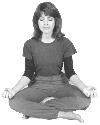 |
Meditation is a way to slow down and control your thinking mind. When your mind is quiet, you gain a peaceful tranquility. You also gain access to the inner workings of your self. These twin benefits are why meditation is of value.
What is Meditation?
Here's the analogy I like most. Imagine yourself within your thoughts. You are in a turbulent, fast-flowing river of thoughts. They carry you along in unpredictable ways. From time to time, you get dragged under and struggle to breathe. Now and then you hit a boulder painfully. Meditation is a way to climb out of the river, and sit on the grassy bank from where you can watch your thoughts. This new grassy perspective is more tranquil and comfortable, and from it -you can learn a lot about the river you normally swim in. You will also learn to be fully conscious - existing in the present moment, rather than running on auto-pilot.
How To Meditate
The first thing to say is that meditation is simple, but it is not easy. You'll need humility and patient practice before you see major benefits. Annoyingly - those who need it most, will find it most difficult to master. There are many ways. Here's the one I use.
Put yourself in a relaxing quiet environment. Be quietly alert, as though you are waiting for a movie to start.
The meditating mind needs a focal point, and I use breathing as mine. Breathe normally, and focus your mind on your breathing. As you breath in, think "in"; as you breath out think "out". For each breath cycle (an IN and an OUT) count "1, 2, 3, ...". Try to eliminate any stray thoughts. Traffic noise, itches, and general mental wandering. This is very hard to do and you will persistently fail! The natural reaction after less than a minute is "Oh, I just can't do this!", but persevere. When you fail, quietly acknowledge that you strayed. I like to think in the third person "He's thinking about dinner" or whatever. Do not become angry or blaming. Just dismiss the thought and start again from 1. Keep doing that for 5 minutes.
Do this often and you'll get better at it. Your straying thoughts will be less frequent; you'll spot them sooner, and dismiss them quicker, so you'll spend more time in the meditative state, which is very pleasant.
Extend your sessions to 10 then 15 minutes. You will find you no longer need the counting - your mind can just sit on your breathing. You'll go into state quicker and more reliably.
When you are reasonably good at this and can spend several minutes at a time without major distractions, you will begin to feel the benefits of a quiet mind, and you'll be ready to use your meditative state to explore.
Using Meditation
Once you can enter a meditative state you can use it in a number of beneficial ways.
Firstly, the meditative state is a pleasant one. You can use it as respite from your troubled life. Half an hour or even 15 minutes will leave you refreshed. Even 60 seconds of meditation can defuse difficult times and provide welcome relaxation and a broader perspective.
Secondly, you can perform "directed meditations". Here are a couple of examples which I find very useful:
1. The Lake
Lay down to meditate. See a large lake. A vast body of water. Elemental. Cradled snugly by ancient rocks. Mother earth. At its depths, the water is cool, dark and still. Strong winds above may cause ripples at the surface, but the vast body of the lake is unaffected. Become the lake. The problems in your life are ripples - not likely to disturb the essence of what you are. Water parts easily, allowing things to pass through it, yet the essence of what it is remains unchanged. You can do the same. Your lake always finds its own level. Inevitable tranquility. When calm, the lake surface reflects the sky and the trees. Now that you are a lake, ask questions of it. How does its surface look right now?This meditation is about discovering your nature, recognising your intrinsic stability, and proportioning the other elements in your life which affect you. It can be very relaxing and comforting and will give you strength to deal in peace and calm with life events. Each time you visit it, you will find new things and deeper insights. And the insights you gain will alter your perceptions, your beliefs and your reality. You will function better and be happier.
2. Dying
This one sounds morbid, but I have found it to be hugely beneficial. Enter a meditative state. Now, in a calm pleasant way, accept that you are dead. Your body no longer functions. Your life as you have known it all these years is finally over. Look around you. Consider the impact of all those things which have made you miserable and occupied your worrying mind for so long. Those extra pounds of fat you carried don't matter even the tiniest bit now. Maybe they never did. The re-decorating you never got around to is pleasantly amusing - what a tiny issue to have ever worried about! The running feud with your sister - what a sad way to waste time and love, but it's all over now, and it doesn't matter any more. Warm wishes to her. Oh, the peace of knowing you'll never have to show up for another work meeting - ever again! And that boss you hated so much - just another human being, bumbling along, confused, hurting. Let it go. Love and let go. Smile and let go. None of it was ever important now that you're here.This meditation is mostly about letting go of the things which do not serve you well. Pride, hurt, some principles, pre-conceptions, ambitions, and more. It's also about proportioning life's events, recognising importance, and about prioritising according to our fundamental values. It imparts a deep understanding of yourself and your place in the world. As with the lake, each time you visit this meditation, you will find new things and deeper insights. And the insights you gain will alter your perceptions, your beliefs and your reality. You will function better and be happier. And the other good news is that you ain't dead yet!
There's so much more to meditation!
Go forth and meditate!
| Take the Next Step | ||||
|
Subscribe to my free Personal Power Newsletters |
You can LIKE this page, send it to a friend:
" data-num-posts="2" data-width="470">
|
|||
| Join
my Facebook Pages
|
||||
| Ready
for The Next Level? |
 |
|||
 below, to join my Facebook main page